Robotics engineering services · AMR · AGV · Cobot · Netherlands

From first schematic to site acceptance, one engineering partner for your robot.

Sisu Logic is a robotics engineering services company. We develop the robot software, fleet management software and safety software for autonomous mobile robots (AMRs), automated guided vehicles (AGVs) and collaborative robots (cobots). We select the hardware, design the electrical systems and support testing, commissioning and acceptance until your robot is certified and running at your customer's site.

Robot software Fleet manager Safety & CE Hardware selection Electrical design FAT · SAT · Commissioning
system overview what we engineer for you
Fleet managersite level
Order dispatch Traffic control Charging & battery WMS / MES link
VDA 5050 · MQTT · OPC UA
AMR
Localization Path planning Motion control Safety
AGV
Line / grid nav Vehicle model Load handling Safety
Cobot
Motion & grip Vision guidance Cell PLC / HMI Safety
Hardware & electricalselected · designed · tested
IPC / SoCSafety PLCSafety scannersDrives & motorsBatteryCabinet & wiringE-stop chain

Engineering experience from projects in

  • Automotive assembly plants
  • Theme park ride systems
  • Consumer goods factories
  • Truck-loading logistics
  • Greenhouse horticulture
  • Traffic infrastructure

Robot types

AMR, AGV and cobot: three kinds of robot, one engineering approach.

The three abbreviations are used loosely in the industry. This is what we mean by them, how they differ, and why the difference matters for the software, the safety case and the electrical design.

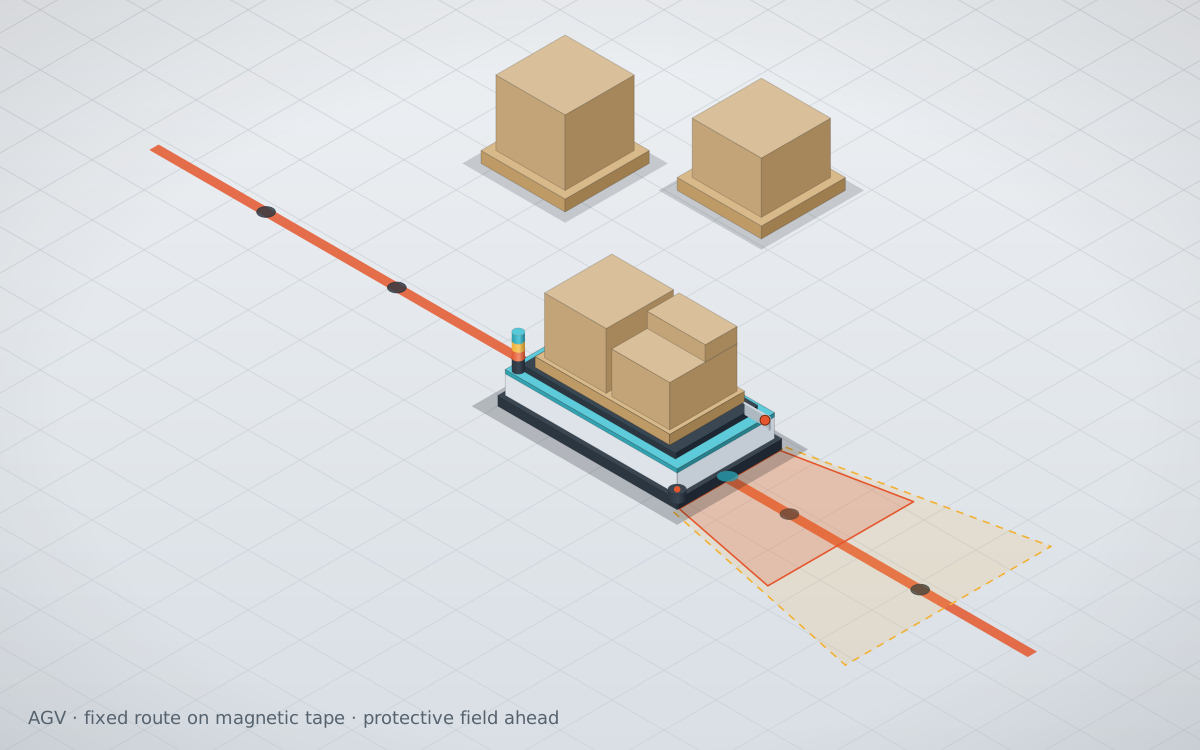
Isometric render of an automated guided vehicle carrying a pallet along magnetic tape, with a protective field projected ahead
AGV
Automated guided vehicle

Drives on fixed routes defined by infrastructure in the floor: magnetic tape, a magnet grid, QR codes, wires or reflectors. It stops when something blocks the path. Predictable and high-throughput, but a layout change means changing the floor.

Navigation
Line or grid following, vehicle model, station positioning
Typical use
Line-side supply and pallet transport in plants
Safety
ISO 3691-4, safety scanners with fixed field sets
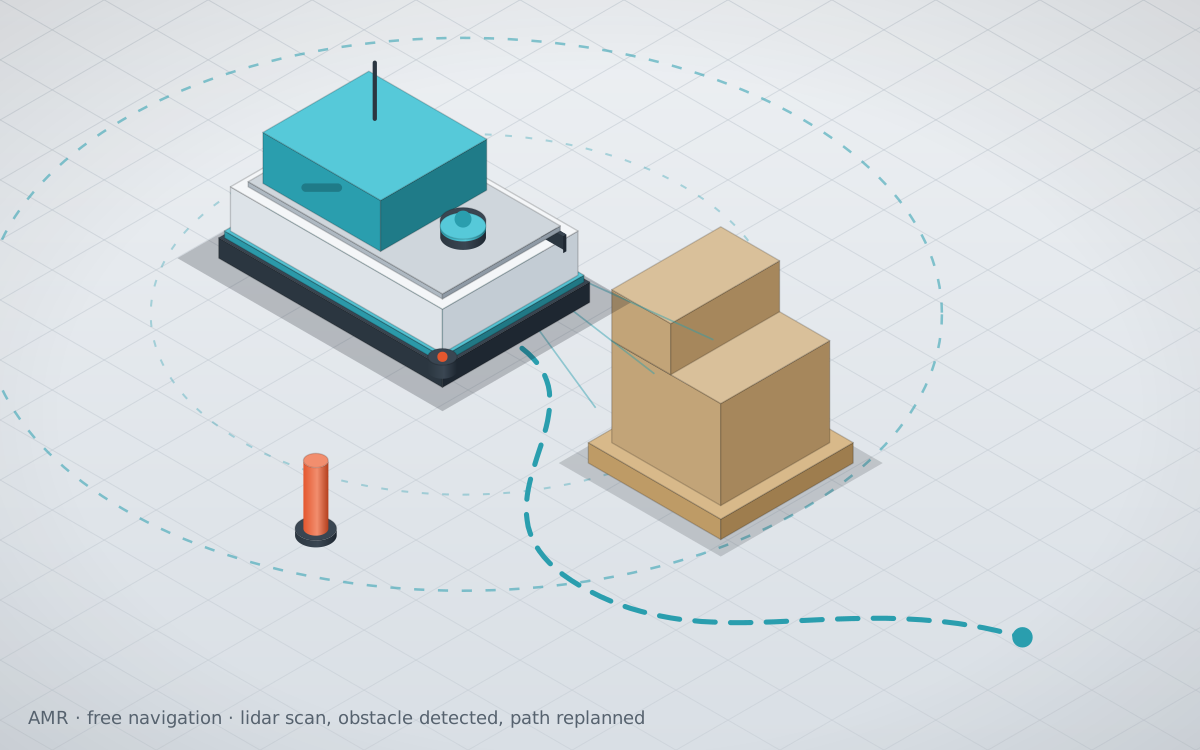
Isometric render of an autonomous mobile robot with a lidar scanning its surroundings and a replanned path around a pallet
AMR
Autonomous mobile robot

Navigates freely using a map and its own sensors, plans its own path and drives around obstacles. No floor infrastructure, quick to redeploy, but far more software and a safety case that has to cover speed-dependent behaviour.

Navigation
Localization, path planning, obstacle avoidance, docking
Typical use
Warehouses, truck loading, greenhouses, hospitals
Safety
ISO 3691-4, speed-dependent protective fields
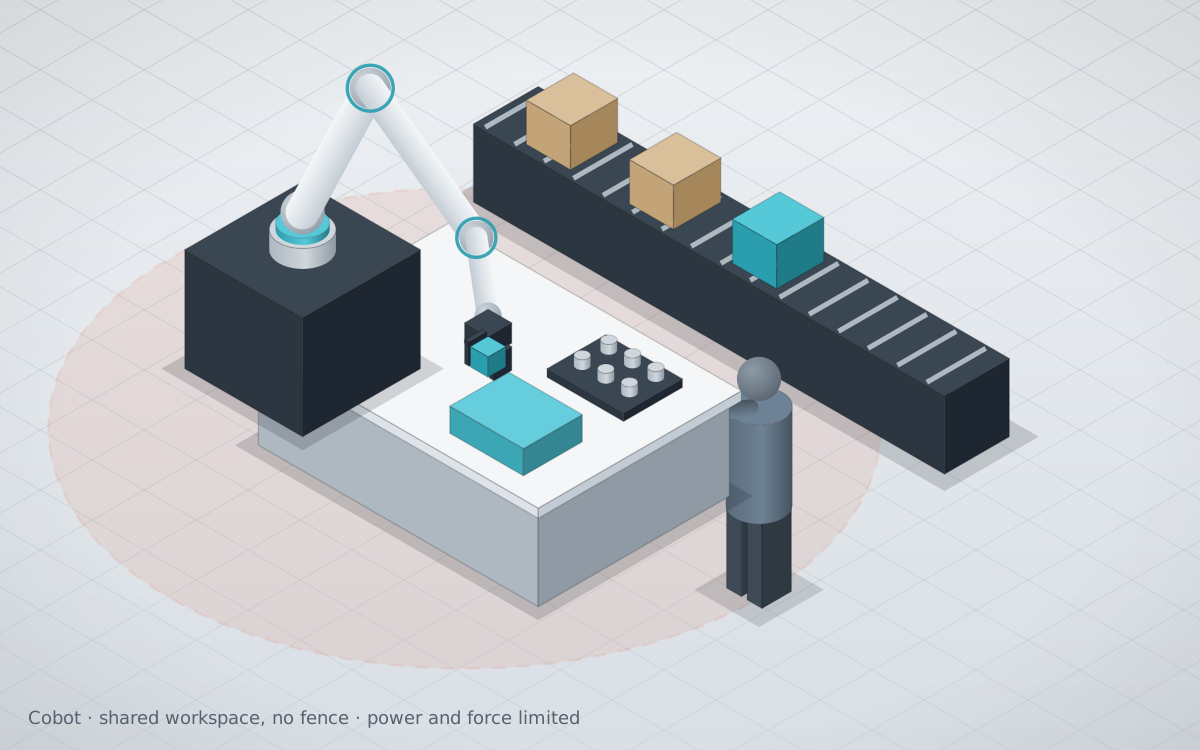
Isometric render of a collaborative robot arm picking parts at a work table beside a person, with no safety fence
Cobot
Collaborative robot

A robot arm designed to work next to people without a fence. Instead of guarding, it relies on power and force limiting, speed and separation monitoring and a carefully designed application. Mounted on an AMR it becomes a mobile manipulator.

Software
Motion, gripper and vision, cell PLC and HMI
Typical use
Machine tending, palletising, assembly, inspection
Safety
ISO 10218, ISO/TS 15066, risk assessment per application

For all three Sisu Logic provides the same six services: robot and fleet software, safety software and certification, hardware selection, electrical design, testing and commissioning, and project and system engineering.

The problem

A robot that drives is not yet a robot you can deliver.

Most robotics projects do not fail on navigation. They stall in the gaps between software, safety, electrical engineering and the customer's floor.

GAP 01

Certification arrives late

The safety case starts after the software works, and the notified body finds a Category 3 requirement the architecture cannot meet. Months are lost redesigning.

GAP 02

Disciplines do not connect

Software, PLC, electrical and mechanics come from different parties. The interfaces between them are exactly where the factory acceptance test fails.

GAP 03

The site is not the lab

Wi-Fi roaming, floor transitions, doors, lifts and people. What passed in the workshop needs engineers who have commissioned robots on real floors.

Sisu Logic closes these gaps by covering software, safety, electrical engineering and commissioning in one team, so they are designed out early instead of discovered at the customer.

12+years of AGV, AMR and safety-critical software
6+vehicle kinematics engineered for production use
3continents where systems we engineered run daily
CE · ANSIcertification routes completed with notified bodies

Services

Everything between the idea and the handover.

Six engineering services that cover the full life of a robotics project. Take one, or let us carry the project from the first requirement to the signed site acceptance.

01

Robotics software development

All the modules an AMR, AGV or cobot needs, plus the fleet manager above them.

  • Navigation, localization, path planning, motion control
  • Perception, task execution, behaviour coordination
  • Fleet manager: dispatch, traffic, charging, WMS/MES
  • Cobot cells: motion, vision guidance, PLC and HMI
See the module map
02

Safety software & certification

The safety concept, the safety software and the route through CE, UKCA or ANSI certification.

  • Risk assessment and safety concept to ISO 13849-1
  • Safety PLC software, protective-field design and validation
  • Safe behaviour across the complete task cycle
  • Technical file and witnessed tests with the notified body
How we certify
03

Hardware selection

Independent advice on the components your robot is built from, matched to payload, speed, environment and budget.

  • Compute: industrial PCs, SoCs, real-time controllers
  • Sensors: safety scanners, lidar, cameras, encoders, IMUs
  • Drives, motors, batteries and charging
  • Safety PLCs, I/O and communication hardware
Hardware & electrical
04

Electrical design

Schematics, cabinet layout and wiring for robots and robot cells, designed for certification from the first drawing.

  • Electrical schematics and cabinet design
  • Safety circuits, E-stop chains, safe torque off
  • Power distribution, battery systems, charging contacts
  • Documentation to EN 60204-1 and IEC 60204-1
Hardware & electrical
05

Testing & commissioning

Structured acceptance from the workshop to the customer's floor, with protocols that stand up to an auditor.

  • Electrical acceptance tests (EAT)
  • Factory acceptance tests (FAT)
  • Commissioning of robots and robot cells on site
  • Site acceptance tests (SAT) and performance runs
Our process
06

Project & system engineering

Implementation support at the customer: requirements, interfaces and integration until the system is accepted and in use.

  • Requirements, system architecture and interface definitions
  • Site surveys, layout and integration planning
  • Coordination between software, mechanics, electrical and IT
  • Operator training and structured handover
Our process

Software

Every module a robot needs. And the fleet manager above it.

We build complete robot software stacks or individual modules that drop into yours. The same engineering standard applies to both: C++ and Python, ROS 2 or native, unit-tested, in your CI, documented for the engineers who come after us.

AMR · AGV

Mobile robot software

From magnet-grid AGVs to free-navigating AMRs on new hardware.

  • LocalizationLidar SLAM, natural features, reflectors, magnet grid, QR floor codes, sensor fusion with odometry and IMU.
  • Path planning & navigationGlobal and local planning, lane and free navigation, dynamic obstacle avoidance, docking.
  • Motion control & vehicle modelsDifferential, diagonal, tricycle, omnidirectional and rear-wheel drive kinematics; trajectory tracking.
  • PerceptionObstacle detection, 3D camera and lidar processing, pallet and load detection.
  • Task execution & behaviourMission state machines, load handling, lift and conveyor control, error recovery.
  • Diagnostics & logging24/7 logging, log replay, on-robot dashboards, remote diagnostics.
  • PlatformEmbedded Linux and Yocto, real-time control, CAN and EtherCAT drivers, OTA updates.
COBOTS

Collaborative robot cells

Application software for cobot cells that work next to people.

  • Robot programming & motionApplication logic, trajectories, palletising and machine tending on UR, Fanuc CRX, KUKA, ABB and others.
  • Gripper & tooling integrationElectric and vacuum grippers, tool changers, force-torque sensing.
  • Vision guidance2D and 3D vision for picking, inspection and pose correction; calibration and hand-eye.
  • Cell controlPLC and HMI software, cell state machines, conveyor and fixture control.
  • Collaborative safetySpeed and separation monitoring, power and force limiting, safety zones to ISO 10218 and ISO/TS 15066.
  • Mobile manipulationCobot on AMR: coordinated navigation and arm tasks, docking accuracy, shared safety.
FLEET MANAGER

Fleet management software

The system that turns a set of robots into a working operation.

  • Order management & dispatchOrder intake, task assignment, priorities, multi-robot optimisation.
  • Traffic managementRoute reservation, deadlock avoidance, intersections, doors, lifts and shared zones.
  • Charging & battery strategyOpportunity charging, charger allocation, battery health.
  • Enterprise integrationWMS, MES and ERP interfaces, REST and OPC UA, call buttons and stations.
  • Open standardsVDA 5050 for mixed fleets, MQTT brokers, vendor-agnostic robot adapters.
  • Operations UILive map, fleet status, alarms, KPIs and reporting for operators and maintenance.
Interfaces we speak
  • ROS 2 / ROS 1
  • VDA 5050
  • OPC UA
  • MQTT
  • REST
  • Modbus TCP
  • PROFINET / PROFIsafe
  • EtherCAT
  • CANopen
  • Siemens S7
  • SICK Flexi Soft

Safety & certification

Safety designed in, validated on the floor, signed off by the notified body.

A robot that is not certified does not ship. We write the safety concept before the first line of code, implement it in the safety PLC and the control software, and validate it with test protocols witnessed by the notified body. The result is a technical file your company owns and can maintain.

  • Risk assessment (ISO 12100) and safety requirements specification
  • Safety concept with PL / Category targets per function
  • Safety PLC software: Flexi Soft, Siemens S7-1500F, Pilz
  • Protective-field sets generated from the vehicle model and validated automatically
  • Safe behaviours for docking, lifting, handover and recovery
  • Validation plan, witnessed tests and the CE technical file
  • ISO 3691-4
  • ISO 13849-1/-2
  • IEC 62061
  • ISO 10218-1/-2
  • ISO/TS 15066
  • ISO 12100
  • EN 60204-1
  • ANSI/ITSDF B56.5
  • ANSI/RIA R15.08
  • Machinery Regulation (EU) 2023/1230
Speed-dependent protective fields of an AMR Top view of an autonomous mobile robot. The laser scanner's protective and warning fields extend further as the vehicle speed increases. Protective fields · top view safety scanner 270° · 1 : 40 mm grid field set 1 v ≤ 0.6 m/s PF 0.75 m · WF 1.1 m field set 3 v ≤ 1.5 m/s PF 1.6 m · WF 2.1 m PL d · Cat. 3 · ISO 13849-1 ISO 3691-4
Speed-dependent field sets, generated and validated by our tooling protectivewarning

Hardware & electrical

The right components, wired right.

Software is only as good as the hardware under it. We help you choose components that fit the application and the certification route, then design the electrical system around them.

HARDWARE SELECTION

Vendor-independent component advice

We have no resale margin on anything. Recommendations follow the payload, speed, duty cycle, environment and the safety functions the robot has to perform.

  • Compute: industrial PCs, NVIDIA Jetson and other SoCs, real-time controllers
  • Safety laser scanners, 3D cameras, lidars, encoders, IMUs, bumpers
  • Drive systems: servo and BLDC drives, motors, gearboxes, wheel modules
  • Batteries, BMS, charging stations and charging contacts
  • Safety PLCs, safe I/O, safety relays and wireless E-stops
  • Networking: industrial Wi-Fi, 5G, fieldbus and IO-Link hardware
  • Cobot arms, grippers, tool changers and vision systems
Trade-off matricesTotal cost of ownershipLead-time riskObsolescence check
ELECTRICAL DESIGN

Schematics and cabinets built for certification

Electrical design for mobile robots and cobot cells, from the single-line diagram to the wiring list, with the safety circuits that the technical file will ask for.

  • Electrical schematics, cabinet layouts and panel design
  • Safety circuits: E-stop chains, safe torque off, safe-speed monitoring, muting
  • Power distribution, 24/48 V DC architectures, battery and charging circuits
  • Motor, drive and brake wiring; sensor and fieldbus cabling
  • Cable schedules, terminal plans, bills of material
  • Compliance with EN 60204-1 and the Low Voltage and EMC directives
  • Electrical acceptance tests and as-built documentation
EPLAN Electric P8AutoCAD ElectricalSEE ElectricalEN 60204-1

Process

From requirements to site acceptance.

A robotics project is accepted in stages, and each stage has a document and a test behind it. This is how we run a project end to end. Join at any phase; the deliverables stay the same.

  1. Requirements & concept

    Site survey, use cases, throughput, layout and interfaces. System architecture and the certification route agreed with you and your customer.

    → System requirements · architecture
  2. Hardware selection

    Components chosen against the requirements and the safety functions. Suppliers, lead times and costs on the table.

    → Bill of materials · trade-off report
  3. Electrical design

    Schematics, cabinet and wiring design with the safety circuits included from the start.

    → Schematics · cable schedules
  4. Software development

    Robot modules, fleet manager and cell software built in short iterations, tested on hardware every week.

    → Tested releases · design docs
  5. Electrical acceptance test

    Cabinet and robot wiring verified against the schematics: insulation, earthing, E-stop chain, I/O checks.

    → EAT protocol · signed
  6. Factory acceptance test

    Functional and safety tests in the workshop with your customer present. Performance, failure modes and safety functions demonstrated.

    → FAT protocol · punch list
  7. Commissioning on site

    Installation support, mapping, field configuration, integration with WMS, doors, lifts and stations. Operators trained on the real system.

    → Commissioned system · training
  8. Site acceptance test

    Performance runs under production conditions, safety validation at the site, technical file completed. Signed off, handed over.

    → SAT protocol · technical file

Example projects

Recent work, in a few lines each.

A selection that shows the range of engineering we provide. Clients are described by sector; names and full detail are shared only with their consent and under NDA.

LOGISTICS · TRUCK LOADING

Heavy AMR to CE and ANSI certification

Safety concept to ISO 3691-4 and ISO 13849-1, safety PLC software, on-robot safety dashboard and a ROS 1 to ROS 2 migration. Safety tests witnessed on site by a German notified body.

SafetyROS 2FAT · SAT
INTRALOGISTICS · NEW PLATFORM

Compact-mover AMR on new hardware

Navigation software for hybrid magnet-grid and natural navigation, protective-field sets generated from the vehicle model with automatic validation, 24/7 logging and log replay.

NavigationToolingSICK
HORTICULTURE · GREENHOUSE

Underride AMR with safety PLC

ROS 2 navigation stack, safety cases for the safety PLC, the interface between navigation and the PLC that owns kinematics and safety, and VDA 5050 fleet communication.

ROS 2VDA 5050Safety PLC
AUTOMOTIVE · ASSEMBLY

Prototype AGV family for a car plant

Four vehicle types on one control architecture: diagonal drive for the marriage line, a 1.5 m/s differential mini-mover, a six-axis handling unit and a pallet carrier.

KinematicsCANLead engineering
TURNKEY

Full project delivery

From requirements to site acceptance, with Sisu Logic responsible for software, safety and electrical engineering. Fixed milestones and one point of contact.

CAPACITY · 2–5 DAYS/WEEK

Engineers in your team

Senior robotics, safety or electrical engineering capacity inside your repositories and tools, on site or remote, for as long as the project needs it.

REVIEW · 1–2 WEEKS

Independent second opinion

A review of your safety concept, software architecture or electrical design before the auditor or your customer reviews it.

Industries

Where our engineering is applied.

Mobile robots and cobots behave differently on a car body line, in a cold store and in a greenhouse. We have engineered systems for each and design for the floor the robot will actually run on.

Intralogistics & warehousing

Pallet and tote transport, truck loading, goods-to-person, mixed fleets.

Automotive & manufacturing

Line-side supply, assembly AGVs, machine tending and palletising cobots.

Horticulture & agriculture

Greenhouse underride vehicles, trolley transport, harvest logistics.

Entertainment & ride systems

Trackless ride vehicles and show systems with zero tolerance for a stopped show.

Machine builders & integrators

Extra engineering capacity for OEMs and system integrators under deadline.

About Sisu Logic

Senior robotics engineering, without the overhead of a large firm.

Sisu Logic is a robotics engineering company based in Zwolle, the Netherlands. We provide engineering services to robot manufacturers, system integrators and end users. We do not build or sell robots; we supply the software, safety, electrical and commissioning engineering that gets your robot tested, certified, documented and accepted at your customer.

The company is led by Siar Sultanali, an embedded and robotics engineer with more than twelve years in AGV, AMR and safety-critical systems, including navigation software for AGVs at German premium car manufacturers, trackless ride vehicles for major theme parks, CE and ANSI certification of truck-loading AMRs with a notified body, and ROS 2 autonomy for greenhouse robots. For larger scopes we bring in trusted specialists in mechanics, vision and PLC engineering and run the project as one team.

Sisu is a Finnish word for the stubborn persistence that shows up after the plan has failed and the deadline has not moved. It is the trait that gets a robot through certification and through its first winter on the customer's floor.

References from clients and colleagues are available on request.

12+years delivering AGV, AMR and safety-critical software
3continents where systems we engineered run in production
CE · ANSIcertification routes completed with notified bodies
Siar SultanaliFounder · MSc Embedded Systems, University of Twente
FAQ

Questions we hear first.

Short answers to the questions most new clients ask in the first call.

Do you work with our existing software stack, or only build new?

Both. We join existing ROS 1, ROS 2 and native C++ code bases regularly, and most engagements start with a code and architecture review. We build a new stack only where the existing one cannot meet the requirements.

Can you take the robot through certification for us?

We write the risk assessment, safety concept, safety software and validation protocols, and we run the witnessed tests with the notified body. The legal manufacturer signs the declaration of conformity; we prepare the complete technical file behind it.

Which robot and PLC brands do you support?

We are vendor-independent. Cobots: Universal Robots, Fanuc CRX, KUKA, ABB, Doosan. Safety PLCs: SICK Flexi Soft, Siemens S7 F-series, Pilz. Navigation: in-house stacks, Nav2, BlueBotics ANT and others on request.

Do you also do mechanical design?

Not in-house. For mechanical design we work with trusted partners and own the interfaces between mechanics, electrical and software, or we work directly with your mechanical team.

How do you handle intellectual property and confidentiality?

Everything we produce for you, code, schematics and documents, belongs to you. We sign your NDA before the first technical call and work in your repositories and tools where required.

Where do you work?

We are based in Zwolle, the Netherlands. Commissioning, FAT and SAT happen on site across the Netherlands, Belgium and Germany, and further afield by arrangement. Development work is done remotely or at your location.

Contact

Tell us about the robot.

Send a few lines about what you are building, where it will run and when it has to be accepted. You will hear back within two working days, usually with questions and a proposal for a scoping call.